


Dear Reader
Last month, in a judgement on online child safety, the Supreme Court held that access to and use of the internet is a fundamental right, and that children also have this right. This means that every internet shutdown is technically a suspension of a fundamental right, and must invite greater scrutiny.
The government calls it “temporary suspension of internet”, and the Union government says it does not track the number of such orders issued by states and Union territories.
Think of everything you use the internet for, and you may begin to form a picture of the impact of a shutdown: Lost incomes for gig workers, students unable to meet online application deadlines, and in recent times, people at gatherings and protests losing a critical means of communication.
Further, journalists can face difficulties communicating with newsrooms and verifying information. And this can create information gaps in which rumour and misinformation spread through offline networks.
In January 2020, in a petition about the continued internet shutdown in Jammu & Kashmir following the abrogation of Article 370, the Supreme Court said suspension orders must be published and are subject to judicial review.
It also held that restrictions on speech and trade carried out through the internet must meet constitutional requirements, including proportionality. This week, we look at how and where India shuts down the internet.
Elsewhere, with COP31 under way, we explain why India must include health better in its climate goals.
Disconnected
In the last 15 years, India has shut down the internet 935 times, according to our analysis of data compiled by the Software Freedom Law Center (SFLC). On average, that translates roughly to one shutdown every six days. The number of incidents reached 136 in 2018, and 2026 had the fewest shutdowns in a decade.
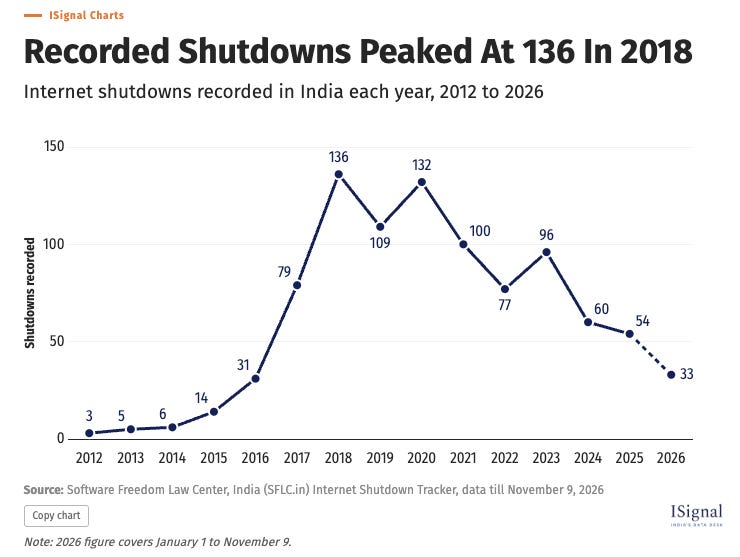
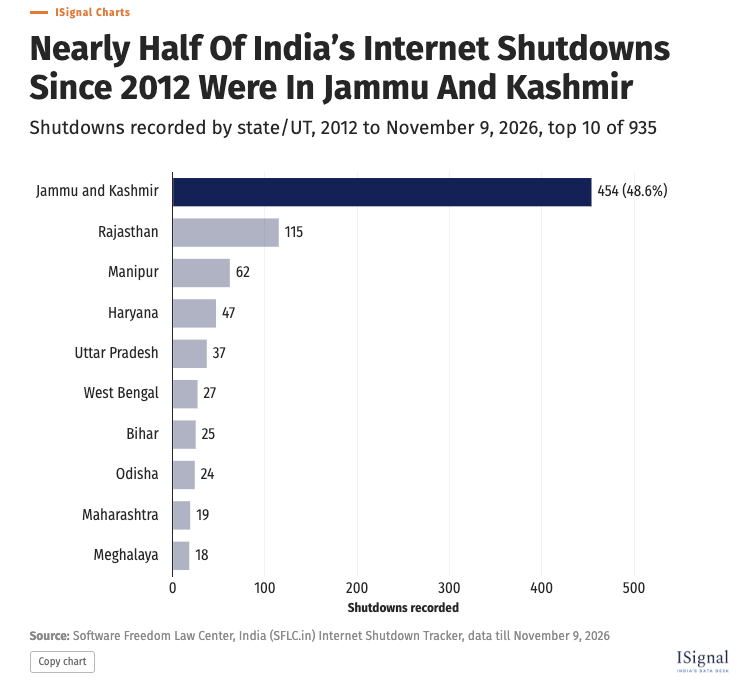
Jammu and Kashmir recorded nearly half the shutdowns, and the 2019 suspension lasted 552 days, the longest in the country. Manipur’s statewide shutdown, imposed after violence broke out in May 2023, lasted 200 days.
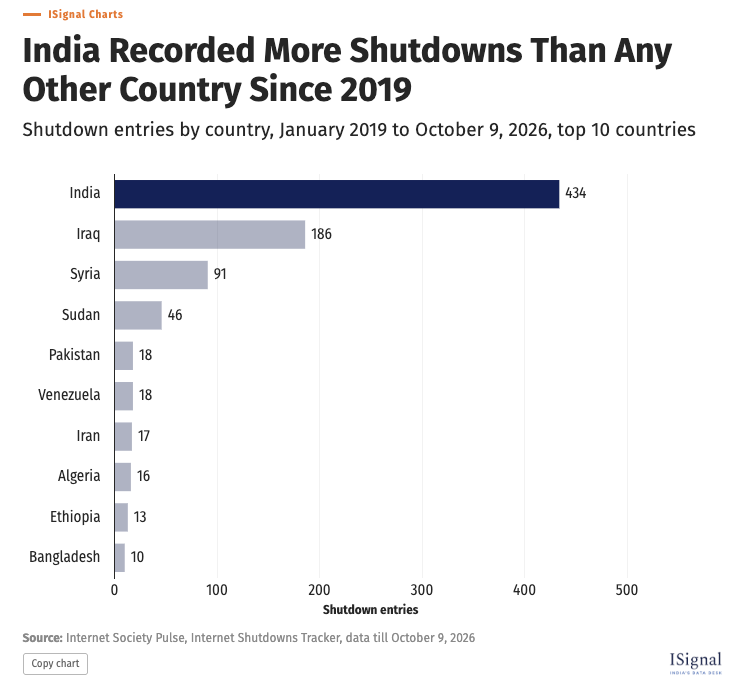
Separately, the Internet Society’s Pulse tracker showed that India had the highest number of shutdowns globally since 2019. The two trackers have different coverage and methodologies and are not directly comparable.
The Internet Society noted that about 14% shutdowns attributed ‘protests’ as the cause, while about 6% each listed exams or elections as the cause.
Nearly three in four simply listed the cause as ‘government action’, which included orders such as a April 2026 incident from Manipur which cited the “prevailing law and order situation”, and a March 2025 shutdown in parts of West Bengal’s Birbhum district “in view of recent events in some areas”.
Vijay Jadhav explains in six charts.
Health in the climate plan
A recent analysis of 132 Nationally Determined Contributions ranked India in the bottom five of the list, for failing to effectively include health in its national climate plan.
The analysis, by the Global Climate and Health Alliance, looks at factors such as health sector resilience, coordination between various ministries, and measures to address air pollution. India’s NDCs mention the word ‘health’ six times, and do not refer to air pollution considerations.
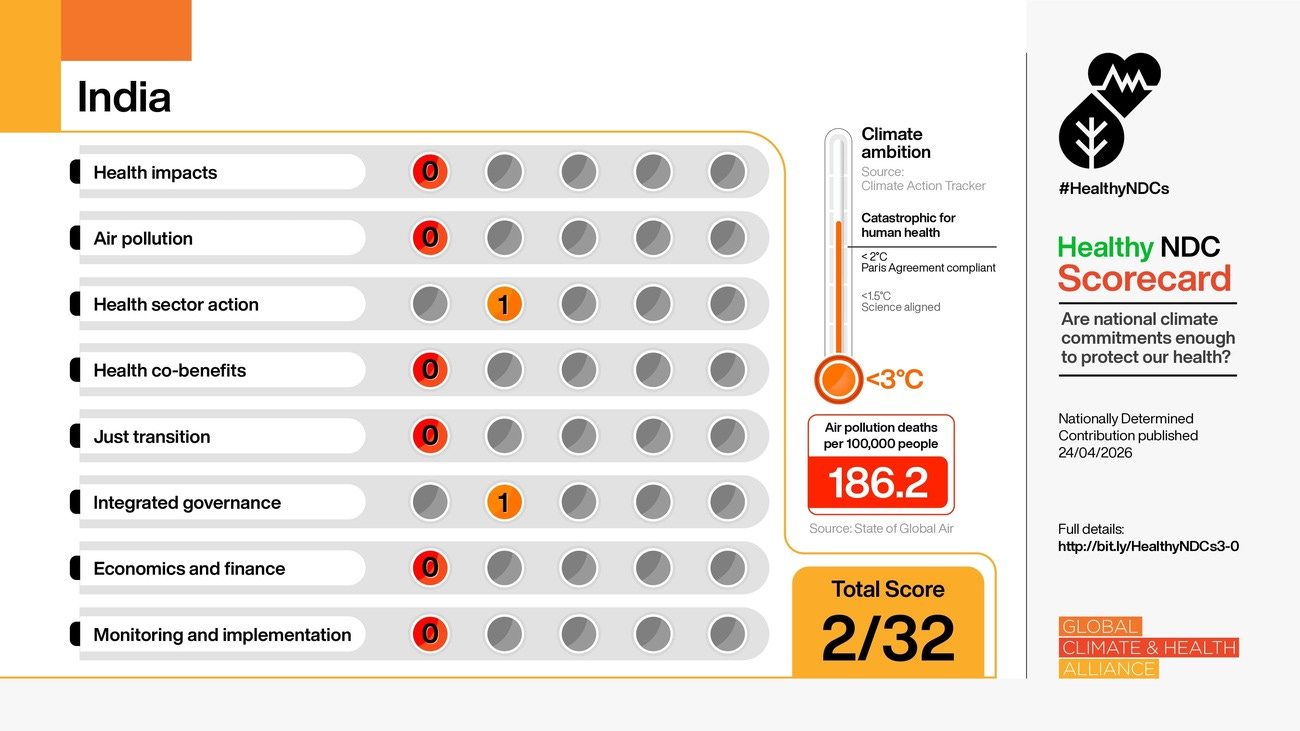
“India’s NDC is brief, at only 34 pages, whereas Sri Lanka’s is more detailed, with many health indicators and sector-wise chapters, at 114 pages. This explains the difference in the GCHA score,” said Manjunath Shankar, senior policy advisor at the Centre for Social and Economic Progress. “Things are happening on the climate-health front in India, though more can be done, but even what is underway has not been articulated well.”
Within existing constraints and available resources, said Poornima Prabhakaran, Director at Ashoka University’s Centre for Health Analytics Research and Trends, “there’s a lot of work happening- within the Ministry of Health as well as other ministries like housing and urban affairs, women and child development, agriculture. What is often absent is the lack of coherent action across ministries to ensure effective implementation of programs and policies.”
New studies show that exposure to PM 2.5 led to over 2.2 million deaths in India in 2023, a 22% increase since 2016, and projections show India may see thousands of heat-related fatalities during the severe El Niño in the next three months. India must integrate health more meaningfully into its climate ambitions, Tanvi Deshpande writes.
Have a good weekend!