


Dear Reader
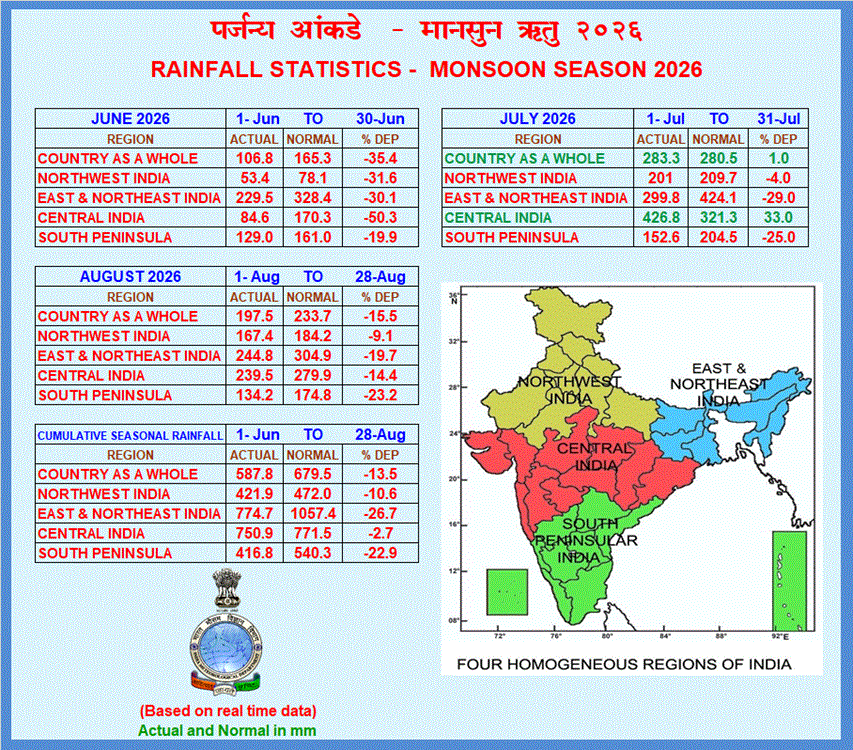
This year, all predictions said India is set to have a below-normal monsoon. With about a month left this season, the country received 13% deficit rainfall compared to the normal (which is the average annual rainfall during 1971-2020). The deficit is most pronounced in East and South India.
Earlier in the season, the government had identified vulnerable districts and advised farmers to opt for short-duration crops and those capable of delivering higher yields with lower water requirements.
How does this affect India’s kharif crop, and with about a month left in the season, what should governments and farmers do to protect incomes, even as El Niño is predicted to get stronger? We spoke with former agriculture secretary Siraj Hussain to find out.
Elsewhere, India plans to conduct at least 14 surveys under the National Sample Survey Office this year, and make better use of its administrative and digital data. In addition, it aims to revamp parts of its statistical system with a renewed focus on state outfits.
But the Ministry of Statistics and Programme Implementation is underfunded, and reports from the government’s auditor flag the lack of statutory support to the statistical commission. We spoke with P.C. Mohanan, who served as acting chair of the National Statistical Commission, to understand the issues plaguing this critical function.
Normal sowing, but lower yields?
India’s sown area is about 1.6 million hectares less compared to last year. That is about four times the size of Goa. But this is considered normal, because it is 1.7% less sowing in a year with currently a 13% deficit in rainfall.
But there are wide variations across states. For instance, Assam and Himachal Pradesh have seen floods or flood-like situations, but east and northeast India received 27% less rainfall compared to the long-period average and the southern peninsula saw a 23% deficit.
The sown crops are at the flowering stage, which will be followed by the critical pod formation and maturity. Even short periods of water stress can cause a loss of yield, explains Siraj Hussain, who earlier served as the Union secretary for agriculture, food processing and industry, and was chairman and managing director of Food Corporation of India (FCI).
But this does not threaten India’s foodgrain. Hussain says there should not be more than 5% loss in foodgrain production, and the FCI has adequate buffer stocks.
The agriculture ministry had earlier advised farmers to take up short-duration crop varieties, but the challenge before the state governments is to ensure supply of high quality seeds, Hussain says, adding that “we don’t know the quantum of climate-resistant seeds actually sold”.
The government did well to identify the most vulnerable districts, Hussain says, explaining that there were regular meetings with state governments to review the progress of sowing and issue of advisories to farmers.
Read Tanvi Deshpande’s interview here.
‘Putting Data On A Server Does Not Make It Statistically Useful’
In 2001, a Commission headed by former Reserve Bank of India governor C. Rangarajan recommended that a statutory National Commission on Statistics be set up as a nodal body to evolve, monitor and enforce statistics priorities and standards, and ensure co-ordination among the different agencies involved.
The Union government set up the National Statistical Commission (NSC) in 2005. About 20 years later, in December last year, a parliamentary standing committee raised questions about the institution’s ability to perform its oversight role, saying that its only notable audit was of the Index of Industrial Production in 2011.
“The Commission is a part-time body that meets perhaps once in two months, and most of its members and the Chairperson have other engagements,” explains Mohanan, a government statistician for over 30 years and a member of the NSC from June 2017 till his resignation in 2019. Mohanan says that in many cases, the Ministry of Statistics and Programme Implementation (MoSPI) decides the agenda or brings specific questions before the Commission, “but how deeply it can examine the issues is doubtful because it has to depend on presentations from the same officials who are involved in producing the statistics”.
Mohanan says some statutory support for the Commission is necessary, suggesting, “Before approving major surveys and censuses, the views of the NSC should perhaps be mandatory.”
The Ministry itself has a funds crunch. MoSPI told the parliamentary committee that against an estimate of Rs 777 crore—or Rs 1 crore per district—under a scheme to help states generate good quality data at sub-state level, allocations stood at Rs 15 crore, based on past expenditure. The Ministry’s estimate itself was about half the requirements of Rs 1,400 crore as indicated by states and Union territories, it said.
India’s survey field staff have not kept pace with a larger population and an expanding workload. As more data collection is outsourced to short-term contract workers, training and institutional memory can suffer, Mohanan adds.
Government portals offer real-time numbers at a scale once impossible, but simply putting data on a server or displaying it on a live dashboard does not make it statistically useful, Mohanan says, adding that independent surveys are important for checking whether administrative data reflects reality.
Read Prachi Salve’s interview here.
Have a good weekend!