


Dear Reader
On August 11, heavy rain flooded an entrance of Noida International Airport at Jewar, months after it opened. On September 4, the approach road and forecourt of Delhi’s airport went under, and 11 flights were diverted. Both instances were dealt with quickly.
Bengaluru-based writer and educationist Chandrika R. Krishnan has made five visits to the mountains in North India in the last decade. And each time, her road journeys have gotten delayed because of landslides.
“I remember waiting it out in Kashmir, Ladakh and Uttarakhand because rainfall-triggered landslides had temporarily blocked the road,” Krishnan told ISignal.
Sustainability, net-zero ambitions and climate adaptation are widely discussed in the context of infrastructure. But the translation of emerging climate risks into engineering design criteria, updated codes and infrastructure planning practices has not progressed at the same pace.
Experts say infrastructure design is relying on historical data, and failing to account for the increasing intensity and frequency of extreme weather events precipitated by climate change. In a new series, we explore how India’s roads and airports can become climate-resilient.
Elsewhere, the 31st Conference of Parties under the United Nations Framework Convention on Climate Change (COP31) concluded last weekend at Antalya, Türkiye without a cover decision being adopted.
A Bumpy Road to Resilience
In 2021, the Rishiganga disaster destroyed a Border Roads Organisation bridge near Raini village in Chamoli, along with other bridges and road sections. The National Disaster Management Authority found that the combination of rock-fall, ice break-off and debris flow exceeded anything previously observed.
In April this year, Union Minister of Road Transport & Highways Nitin Gadkari announced a policy shift to prioritise slope stabilisation before starting the construction of roads in the geologically fragile Himalayan region.
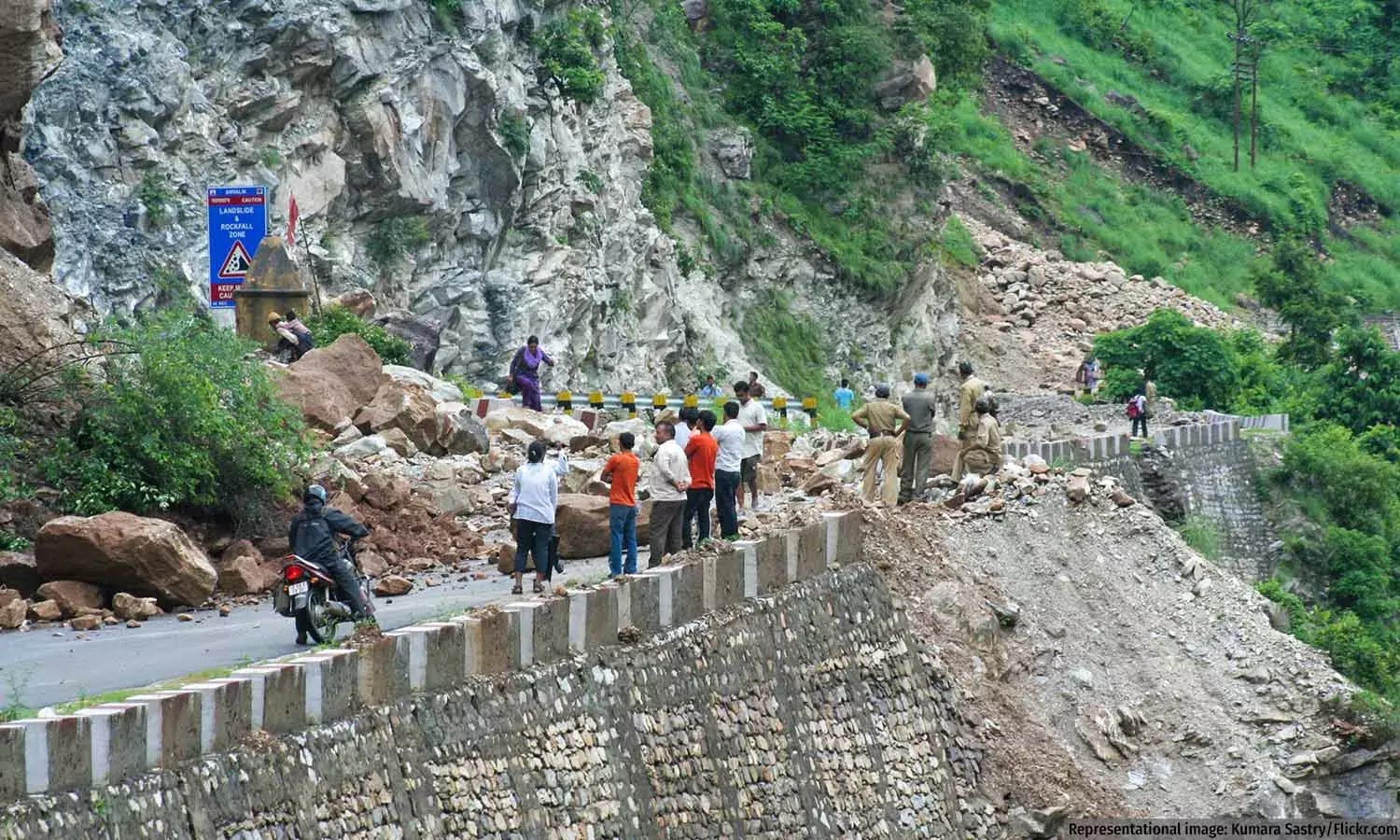
Road construction in the region frequently involves cutting into steep slopes with complex geological and hydrological conditions, explained Satish Pandey, scientist F & head, Flexible Pavement Division, CSIR-Central Road Research Institute, under the Ministry of Science and Technology.
Geological surveys, drainage characteristics, groundwater conditions and landslide susceptibility must be considered at the planning stage, Pandey said. If not, road construction can increase slope instability. Without adequate stabilisation and drainage, and given the concentration of surface runoff, it can further increase the risk of landslides, erosion and road damage during intense rainfall, he explained.
Road and bridge design in India is largely informed by Indian Roads Congress guidelines, specifically, a “return period”, which is an estimate of the average time between extreme weather or flood events of a specific magnitude that could damage the constructed asset.
A highway designed for a, say, 60-year return period, would have a 1.67% chance of seeing that worst case scenario in any given year. But climate change is exacerbating the magnitude of the worst case scenario as well as their frequency.
“Return-period models rely on stationarity, the assumption that past rainfall patterns are a reliable guide to future risk,” Manmohan Singh Deol, technical director at Rodic Consultants, pointed out. This assumption is breaking down. “In today’s times, a road designed to meet a 1-in-100-year flood standard today may be facing that intensity of event far more often within its service life,” he said.
Experts say fragile mountain stretches may need different answers than a uniform two-lane standard: single-lane roads with widened sections, tunnels, viaducts, even rail.
Read Charu Bahri’s report here.
Every Runway Has Its Own Weather
Delhi International Airport’s T3 terminal is situated at a lower elevation than the adjacent National Highway 48 corridor, a fact that is cited as a contributory factor for flooding in the airport precincts.
The Delhi airport’s stormwater drainage system was designed based on the catchment characteristics, projected rainfall intensities and downstream outfall capacities prevailing at the time of development. But over the years, a GMR spokesperson pointed out, the catchment surrounding the airport has undergone significant urbanisation. Even if internal airport drains are adequate, overloaded municipal drains can cause backflow, an expert says.

“Increased impervious surfaces [such as roads, pavements and buildings], modifications to surrounding drainage networks and changing land-use patterns have substantially increased runoff volumes entering the airport precinct,” the spokesperson said.
All this has happened at a time when climate change is driving increasingly intense short-duration rainfall events that can exceed historical design assumptions.
Delhi’s biggest airport risk is winter fog. In Mumbai, Chennai and Kolkata, it is heavy rain. Visakhapatnam and Bhubaneswar face cyclones. With extreme weather events becoming more frequent and intense, each airport needs separate climate risk assessments.
Engineering design for airports must progressively shift from historical-data-driven assumptions to forward-looking, risk-informed & climate-resilient solutions. Specifications then need to translate those risks into practical design needs, Charu Bahri writes.
Antalya Ends Without a Cover Decision
The year 2026 is going to be one of the hottest on record. The global average surface temperature for January–September 2026 was about 1.47°C above the pre-industrial average.
If nothing changes, the world is on track to only limit global warming this century to 2.6°C, far above the Paris Agreement target of 1.5°C, the annual Emissions Gap report found. Global greenhouse gas (GHG) emissions would have to be reduced by 18% by 2030 and 69% by 2040 if warming is to peak around the middle of the century to 1.7-1.8°C. By contrast, as countries’ climate plans stand today, their implementation would only reduce emissions by 5-8% by 2030 and 11-15% by 2035.
It was against this backdrop that delegates from over 200 countries met in Türkiye for COP31. But the conference ended with the cover decision not being adopted.
The draft proposed raising electricity’s share in final energy consumption to 35% by 2035 (a target criticised as potentially prescriptive for developing nations) and included unproven technology of carbon capture, while failing to mention transitioning away from fossil fuels or commit a specific figure toward the estimated $305 billion needed annually for adaptation finance.
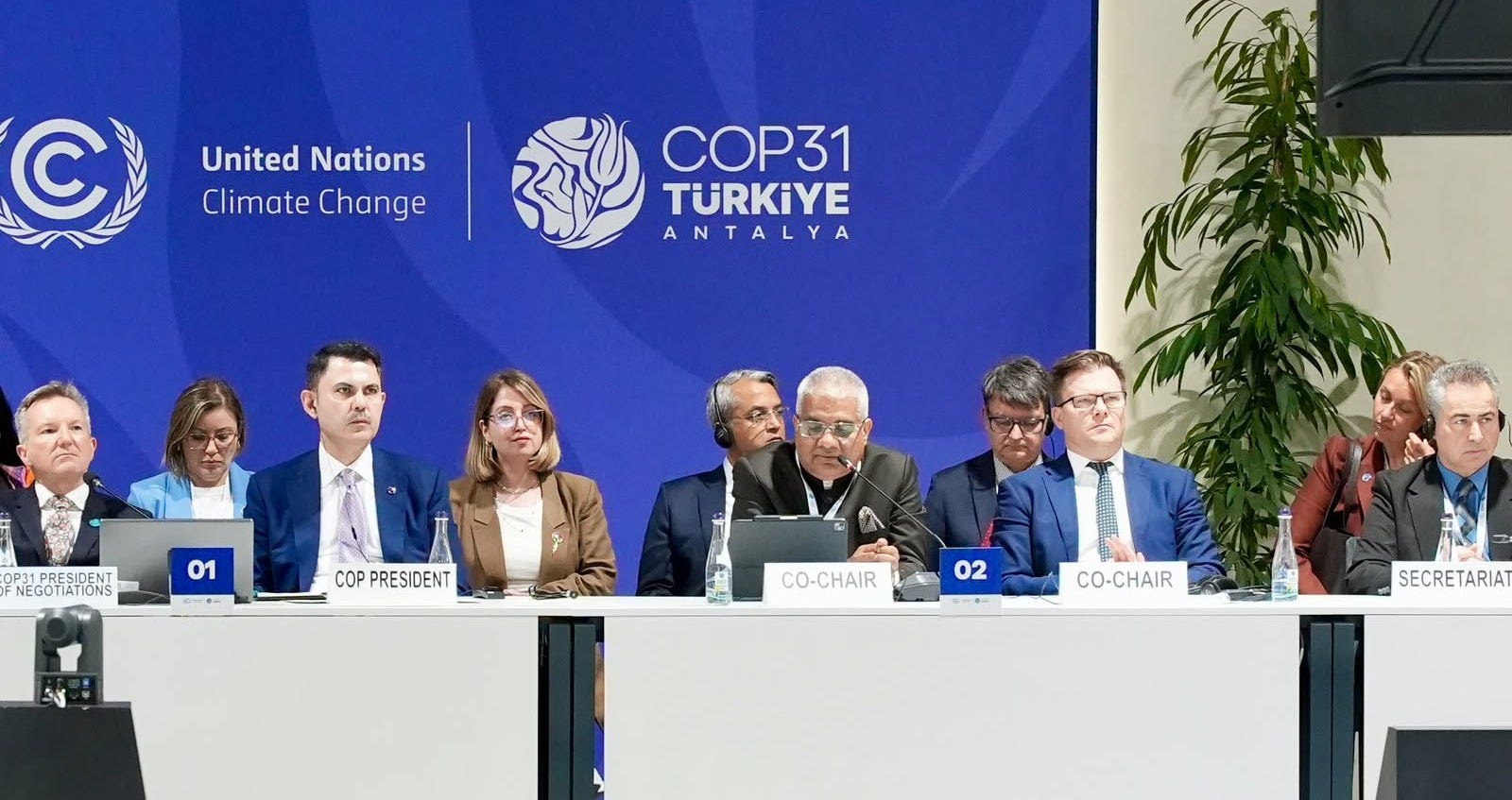
“At the threshold of crossing 1.5°C warming, we had raised a fundamental point—we need to reflect why we are here. Whose emissions—both past and continuing—have exhausted the global carbon budget? The cover decision does not reflect this,” the Indian delegate, speaking on behalf of Like-Minded Developing Countries, said.
“Our partners have refused to engage on the issue of climate finance,” the representative said. “We were told that despite the increasing needs of developing countries due to a problem we have not caused, we should not expect our developed country partners to even engage on the issue of climate finance, since it was ‘dead in the water.’”
Tanvi Deshpande explains in this report.
That’s all for this week. We will be back with more.